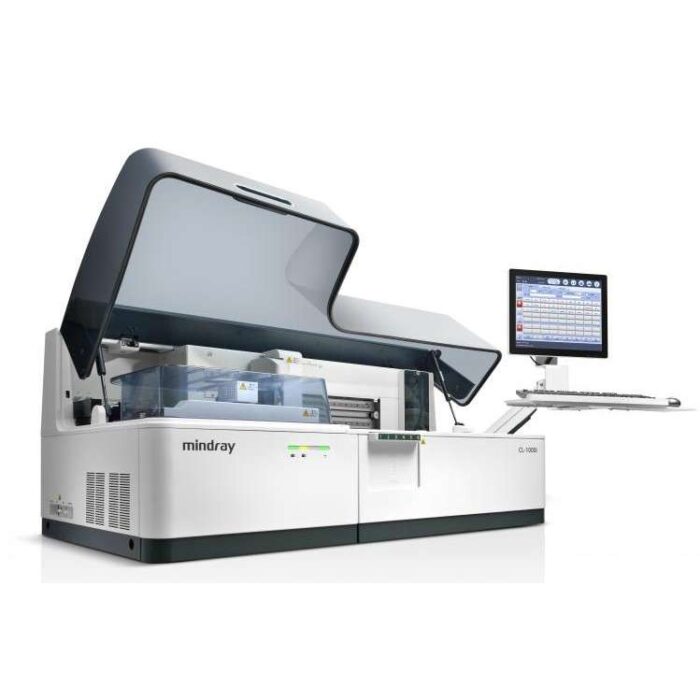

Description
Throughput
– 240 tests/hour (without ISE)
– 360 tests/hour (with ISE for Na⁺, K⁺, and Cl⁻)
Dimensions
1150 × 726.5 × 1150 mm
Weight
350 kg
Additional Equipment
– Integrated ISE module
– PC with touchscreen
– Barcode reader
Reaction Cuvettes
81 high-transmittance reaction cuvettes; disposable cuvettes.
Design and Contamination Prevention
Contamination prevention system featuring automatic probe and mixer washing, an intelligent contamination prevention program, and a carryover rate of 0.005%.
Sample and Reagent Tray
– 40 reagent positions
– 40 sample positions with STAT priority
Sensors
Sample and reagent sensors with liquid-level detection and three-dimensional collision protection.
Refrigerated Sample/Reagent Compartment
4–12°C
Thermostat
Hot-air thermostat for the reaction cuvettes.
Minimum Reaction Volume
150 µL
Test Methods
– End-point method
– Two-point method
– Kinetic method
– Colorimetric method
– Turbidimetric method
Calculation Methods
Linear methods (single-point, two-point, and multipoint), Logit–4P, Logit–5P, spline method, exponential method, and polynomial method.
Wavelengths (nm)
340, 405, 450, 510, 546, 578, 630, and 670; optional 800 nm.
Halogen-Tungsten Lamp
Service life: more than 2,000 hours.
Water Consumption
Less than 2.5 L/hour.
User-Friendly Software
– Multilingual interface
– Easy operation through an icon-based interface
– Powerful statistical system
– Manual dilution, automatic dilution, and post-dilution functions
– Easy test repetition and recovery
Calibration and Quality Control
– Multiple calibration module
– Advanced algorithm for generating an optimal calibration curve
– Multiple quality control rules, including Westgard rules, cumulative sum checking, and dual-chart monitoring
Real-Time Monitoring
– Reaction curves, calibration curves, and QC test results
– Status of samples, reagents, and reaction cuvettes
– Lamp intensity, distilled water level, and waste tank status
– Temperature of the reaction disk and reagent disk